TL;DR
By selling covered calls, you are capping the amount of upside profits you are able to gain while still being exposed to all of the downside risks of owning a stock, so by simply buying and holding the underlying asset, you would outperform the covered call strategy (most times).
Don't Fall For The Trap of Income Investing
It seems that income investing has been getting a lot more popular. The idea of your profits being cash paid out to you as "passive income" instead of an appreciating stock price is lucrative, but income investing, whether by dividend investing, or by covered calls, the main topic of this blog, is a trap and is just a mathematically worse strategy than buying and holding the underlying asset. The "income" generated by covered calls is effectively carved out of the stock price, most times at a rate that lags behind the underlying asset’s performance. And furthermore taxed at a disadvantaged rate compared to typical capital gains, resulting in lower total returns.
What Are You Talking About?
Surprisingly, a lot of my friends that are into covered calls investing, mostly by buying covered call funds like spyi, qqqi, and btci, don't actually know what selling covered calls does and don't understand where their "passive income" actually comes from.
So selling covered calls is basically a strategy where you own an underlying asset, then you sell call options of that asset that acts like a contract that gives the buyer of the call option the right to buy your asset at a predetermined strike price, and for selling that contract, the buyer of the option will pay a premium to you. I think it would be easier if we used an example.
Example
Say you buy 100 shares of SPY at $680 per share.
You then sell call options based on your SPY shares, let's say the strike price of your call option is $685. And for this option, the buyer pays you $4 per share as a premium.
This means that the person that buys your options can choose to buy all your 100 shares of SPY at $685 per share in the future, in exchange for a premium paid to you right now.
And then let's say 10 days later, SPY is on an incredible run and now trades at $710 per share.
Now, because the price of SPY is above the strike price of $685, the buyer of your call option decides to exercise his option and buys all your 100 shares of SPY at $685 per share. You profit $5/share (because you bought SPY at $680) + the premium of $4 per share, which is a total return of $900.
However, if you had just bought the 100 shares of SPY at $680 and simply held it until it got to $710 then sold it, you would've made a profit of $30 per share, which is a total return of $3000.
The Trap
This means that if the stock goes up, you lose because you wouldn't be able to make as much profit than if you were to buy-and-hold.
On the other hand, if the stock goes down, the option buyer simply won't exercise the contract, and you still lose because you would incur almost the entire loss from the dropping stock price (minus the small premium you collected).
This is the trap of covered calls, your profits are capped and your losses are uncapped.
It's a lose lose situation, and this is why I think selling covered calls is a bad strategy. You are sacrificing the amount of your total returns for "income" that is distributed to you, which can be done without covered calls by simply selling the stock. It also seems that a lot of people hate the idea of "selling a stock", but if you really need income, just selling a few shares of stock yields a much higher income than covered calls. You get to keep most of your shares and avoids capping your upside potential.
The Exception To The Rule
I do have to note that there is one situation where covered calls beats buy and hold, and that is if the asset trades sideways and stays stagnant. If you sold covered calls, you would make profits in premiums, but if you had bought and hold the underlying asset, you would've made no profit because the price stagnates. But a long and sustained sideways market happens very rarely and so buying and holding almost always beats out covered calls.
Dividend Investing Isn't Much Better
I just want to quickly touch on dividend investing since we are on the topic of income investing. By dividend investing, you are buying stocks of companies that pays a high dividend, like Coca-Cola, Pepsi, Verizon...etc. But there's a reason why these companies are paying high dividends, and it's because their growth is limited and they use the dividend as an incentive for people to buy their stock. Furthermore, the money that companies spend paying a dividend could be better used if it were reinvested into the business to expand the business and increase shareholder value more than what the dividend can provide.
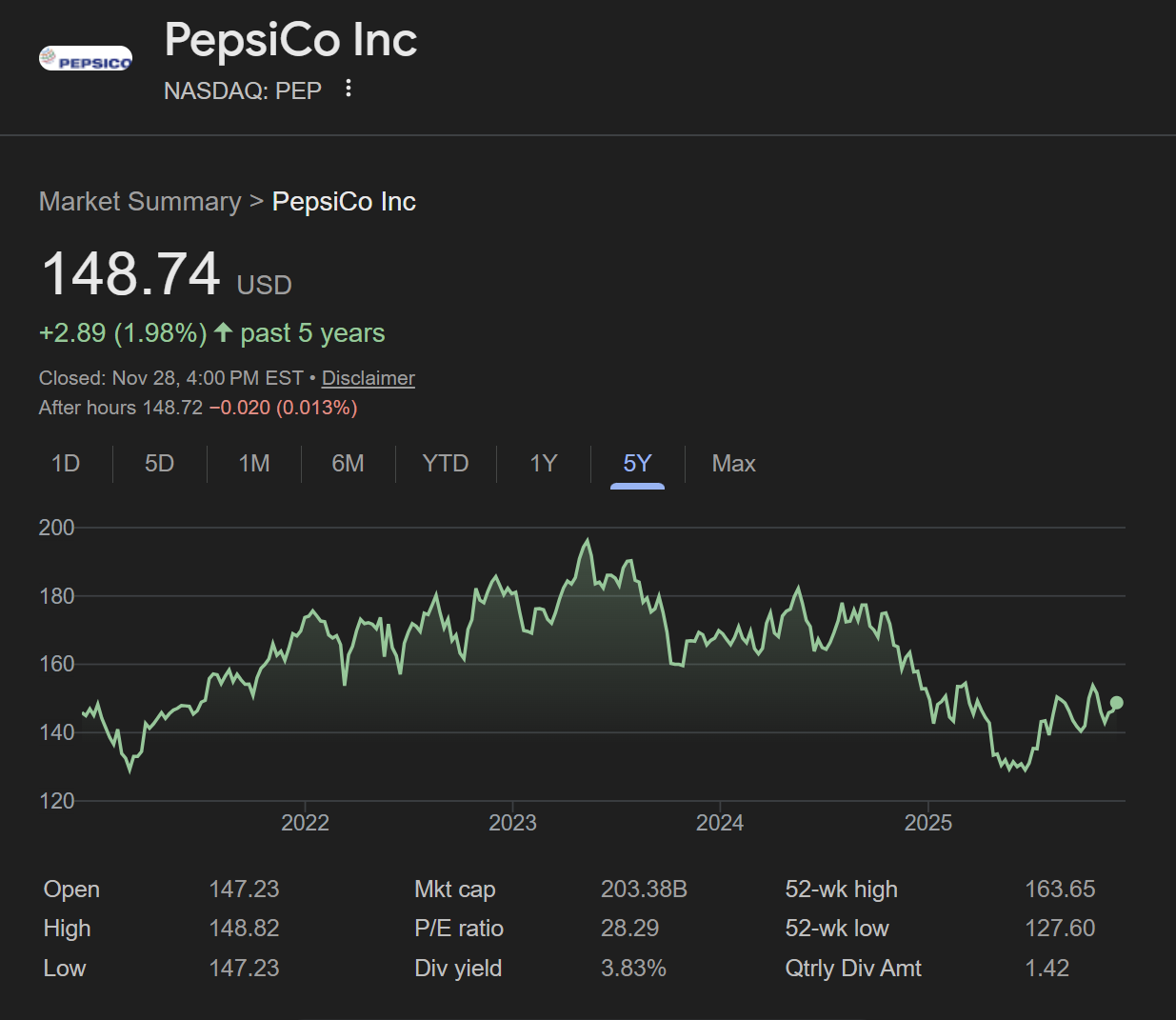
As you can see, Pepsi's stock, a really famous dividend stock, over the last 5 years only returned 1.98%, and with a dividend yield of 3.83%, you are significantly underperforming the market by holding Pepsi stock.
Conclusion
Invest for growth, don't invest for income. Don't buy covered call funds, instead just buy and hold the underlying asset. Bet on companies with big growth potential and not companies that pays a big dividend. If you are really risk averse and want income, buy treasury bonds like SGOV or money market funds like SWVXX, they are as safe as it gets, definitely safer and more consistent than covered call funds. Treasury bonds and money market funds also pay a higher yield than most company dividends.